

July 13, 2026 · 10 min read · Updated July 30, 2026
Written by Nirav Kalola , CEO @ Kode Creators
Machine Learning In Healthcare: Future Trends and Benefits
AI Solutions
Healthcare
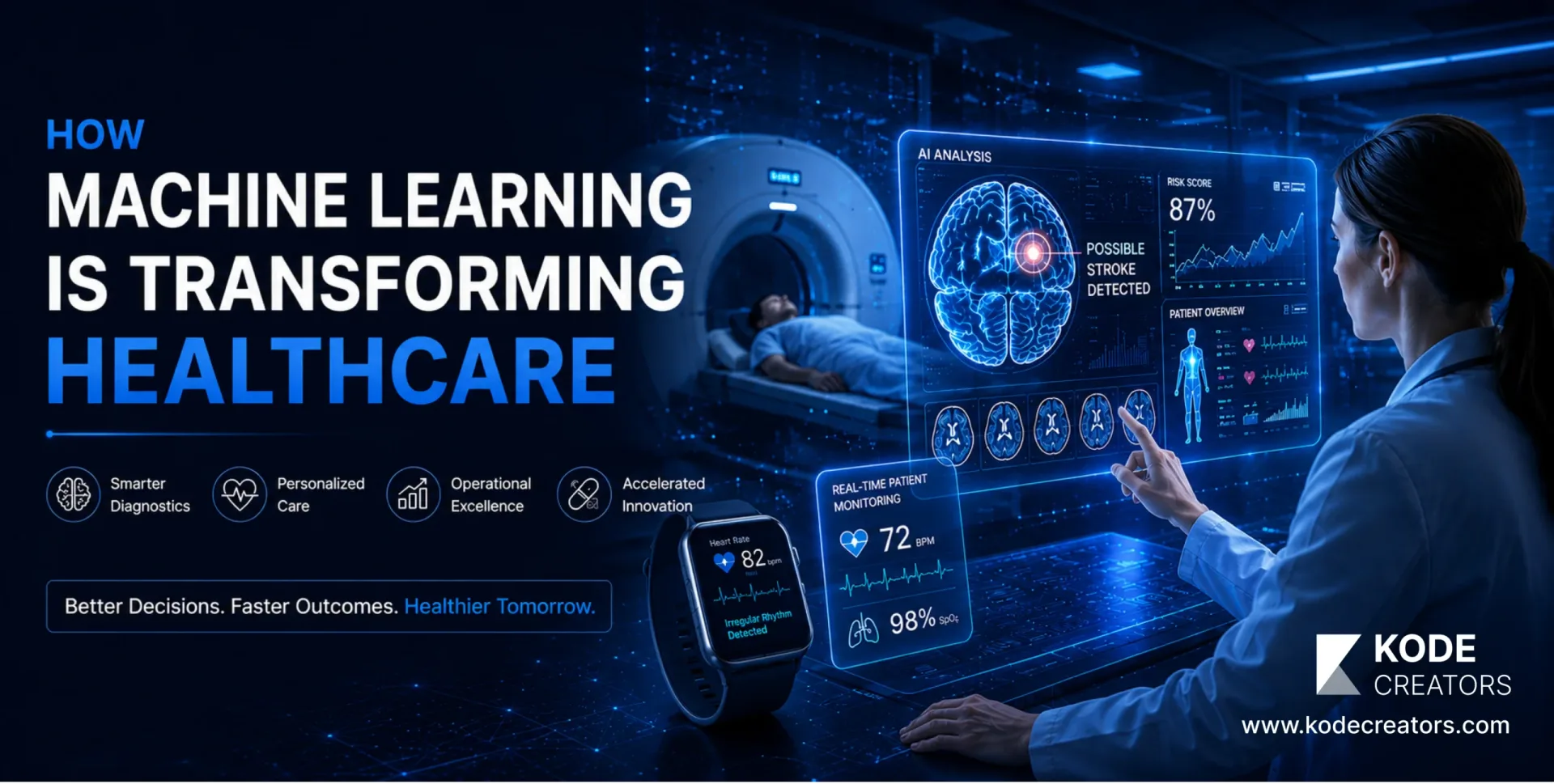
A CT scan flags a potential stroke before the patient even reaches the ward. A smartwatch nudges a doctor about an irregular heartbeat that would’ve gone unnoticed a decade ago. Quietly, almost invisibly, machine learning has slipped into everyday healthcare, and it’s already changing how decisions are made.
Healthcare is finally reaching a stage with ML that spots patterns humans can’t, cuts through administrative overload, and helps clinicians act faster and with better context. As healthcare data keeps exploding and expectations around speed and accuracy rise, machine learning is shifting from “nice to have” to foundational.
In this piece, we’ll look past the buzzwords and break down where machine learning in healthcare actually delivers value today, the trends shaping what comes next, and what it really takes to implement these systems without compromising trust, safety, or outcomes.
Where We Are Now: ML’s Role in Healthcare Today
The healthcare AI market hit $15 billion in 2024, and nobody’s surprised anymore. What’s surprising is where the money’s actually going – not to flashy robots or sci-fi diagnostics, but to boring problems that cost fortunes. Radiology departments process 40% more images using ML triage that sorts urgent cases from routine screens. Prior authorizations that took insurance companies three days are now clear in three minutes. Emergency departments can predict patient surges hours in advance, calling in staff before waiting rooms explode.
The adoption signals tell the real story. 75% of large health systems now run ML in production, not pilots. The VA uses ML to predict suicide risk. Kaiser prevents readmissions with algorithms that know which discharged patients will crash. These aren’t experiments; they’re standard operations.
The implementations that survived share DNA: they automate drudgework (documentation, coding, scheduling), augment decision-making (drug interactions, diagnosis support), or catch what humans miss (early deterioration, billing errors). Nobody’s replacing doctors. They’re replacing the parts of healthcare that shouldn’t require medical degrees – and doing it well enough that hospitals can’t afford to adopt.
Core Benefits Explained with Metrics to Prove Them
Faster, More Accurate Diagnostics: The dirty secret of medical imaging is that accuracy plummets after a break. Radiologists miss things when they’re tired, rushed, or just human. ML doesn’t have bad days. It flags suspicious areas on scans that exhausted doctors might skip, catches rare diseases that most physicians see once per career, and maintains the same accuracy at midnight as noon. We’re seeing false negative rates drop by a third when ML provides second opinions – that’s thousands of cancers caught while still treatable.
Personalized Treatment & Risk Prediction: Cookie-cutter treatment plans are dying because ML has finally cracked the code on why the same drug works miracles for some patients and does nothing for others. Algorithms now predict which diabetics will crash next week, which psychiatric patients need intervention tomorrow, and which surgical patients will develop complications. It’s not magic – it’s pattern recognition across millions of cases, finding signals humans don’t tend to process. Treatment response rates jump significantly when plans account for individual genetics, history, and lifestyle patterns.
Operational Efficiency & Cost Savings: Hospitals hemorrhage money on problems ML solves in its sleep. Scheduling optimization that prevents million-dollar operating rooms from sitting empty. Billing automation that catches coding errors before claims get denied. Supply predictions that eliminate those panicked midnight orders for critical supplies. Organizations report operational cost reductions between 15-30% just from automating the administrative maze that shouldn’t require human intelligence.
Accelerated R&D & Drug Discovery: Drug development traditionally takes a decade because researchers test compounds blindly. ML changes the game by predicting which molecules might work before anyone touches a test tube. Trial recruitment drops from months to days when algorithms match patients to studies. What used to require armies of researchers now happens on servers, cutting development time nearly in half.
Future HealthTech Trends to Watch in 2026
Generative AI & Clinical LLMs: Large language models stopped being chatbots and started doing actual medical documentation. They’re drafting discharge summaries that capture six hours of surgery in two paragraphs, translating “moderate stenosis requiring percutaneous intervention” into language patients understand, and summarizing relevant research from thousands of papers in seconds. The workflow impact is immediate – doctors spend two hours less on paperwork daily. But here’s the catch: these models hallucinate. They’ll confidently describe medical procedures that don’t exist or cite studies never written. Smart implementations keep humans verifying everything while AI handles the grunt work. The sweet spot is augmentation – AI drafts, doctors edit, patients get better documentation faster.
Federated Learning & Privacy-Preserving ML: Small hospitals have small datasets, which means crappy ML models. Federated learning solves this by training algorithms across multiple institutions without moving patient data anywhere. The model travels to the data, learns locally, then shares only the learning patterns – never the actual patient information. A cardiac arrest prediction model improves its accuracy by learning from twenty hospitals simultaneously, while each keeps their data locked down. This isn’t theoretical – major health systems are already running federated pilots because it solves healthcare’s biggest ML problem: insufficient data for rare conditions.
Edge ML + Wearables: Your smartwatch detecting AFib was just the beginning. Edge processing means ML runs directly on devices without cloud connectivity – critical when seconds matter, or networks fail. Continuous glucose monitors predict dangerous drops three hours early. Smart beds detect movement patterns suggesting imminent falls. Post-surgical monitors catch infection markers before fever spikes. The revolution isn’t the monitoring – it’s processing data instantly where it’s generated, triggering interventions before problems escalate.
Digital Humans & AI Agents: That 3 AM call about medication side effects doesn’t need a human anymore. Digital nurses handle routine questions, triage symptoms, and provide post-discharge support with surprising effectiveness. They detect emotional distress in voice patterns, adjust communication for health literacy levels, and seamlessly escalate when human intervention is needed. The ROI is undeniable – one digital agent handles the workload of three human staff for routine interactions, freeing nurses for actual nursing.
Explainability & Equity-First AI: Black-box ML is dying in healthcare because regulators and patients demand answers. New frameworks show exactly which factors drive predictions, where bias hides, and why certain populations get different results. Models that work great for one demographic but fail for others are getting caught and fixed before deployment. It’s not just ethical – it’s becoming legally required as healthcare AI regulations mature.
Implementation Roadmap — From Pilot to Production
Start with the Right Use-Case
Pick problems that annoy everyone but won’t kill anyone if ML fails. Appointment scheduling, documentation assistance, and billing code optimization – these have clear ROI without clinical risk. Define success metrics that finance understands: reduce no-shows by 25%, cut documentation time by 2 hours daily, and increase clean claim rates to 95%. Your first win needs to be obvious and measurable. Deliverable: one-page use case with problem statement, success metrics, and 90-day pilot timeline.
Data Audit & Governance
Healthcare data is messier than anyone admits. Start by documenting what you actually have versus what you think you have. Create data schemas that enforce consistency – if “diabetes” appears seventeen different ways in your system, ML will fail. Check demographic representation religiously. Build governance policies for data access, retention, and quality monitoring that survive staff changes. Deliverable: data quality scorecard showing completeness, accuracy, and demographic distribution, plus a governance framework document that legal and IT approve.
Model Validation & Clinical Trials
Shadow mode is your friend – run ML predictions alongside human decisions without affecting patient care. Compare outcomes for at least 90 days. Design prospective validation that would satisfy peer review, not just internal metrics. Get clinicians involved early with interfaces they’ll actually use, not theoretical dashboards. A/B testing isn’t optional when lives are involved. Deliverable: clinical validation protocol with statistical power calculations, user acceptance criteria signed by department heads, and published validation results.
Integration & Interoperability
Your ML needs to speak ancient healthcare languages. Build APIs that handle HL7, FHIR, and whatever proprietary format your 1990s system demands. Plan for network failures, data inconsistencies, and the reality that patient names appear differently across systems. Test integration with actual production data, not clean test datasets. Deliverable: technical integration plan with API specifications, failure handling procedures, and successful integration testing across all connected systems.
Monitoring & Retraining
Models drift faster than you’d expect. Set up dashboards tracking accuracy, usage, and edge cases. Define triggers for retraining – not calendar dates but performance thresholds. Document every model update for regulatory compliance. Build incident response procedures before incidents happen. Deliverable: monitoring dashboard with automated alerts, retraining triggers document, and incident response playbook that assumes 2 AM failures.
Risks, Ethics & Regulatory Checklist
Healthcare ML that ignores ethics becomes evidence in lawsuits. The scandals write themselves – algorithms that work perfectly for white patients but fail for minorities, black-box decisions that can’t be explained to regulators, data breaches exposing ML training sets containing millions of records. Smart organizations build ethics into architecture, not bolt it on after problems surface.
Your survival checklist for healthcare ML:
Demographic bias auditing across all patient populations – Test performance separately for age, race, gender, and socioeconomic groups. If accuracy drops for any group, stop deployment until it is fixed.
Explainability documentation for every prediction – Regulators will ask why your model made specific decisions. “The algorithm said so” ends in penalties. Document feature importance and decision pathways.
Informed consent that patients actually understand – Not legal jargon but a clear explanation of how ML affects their care, what data gets used, and opt-out procedures.
Data minimization with deletion schedules – Collect only what’s needed, delete when done. Training on decades of data sounds smart until breach lawsuits arrive.
Security beyond HIPAA minimums – ML models are attack vectors. Implement differential privacy, model encryption, and adversarial testing.
Regulatory mapping for your actual markets – FDA clearance doesn’t mean EU approval. India’s CDSCO has different requirements. Map regulations before development, not after
Measuring Success: KPIs & ROI Framework
Hospital executives care about metrics that affect budgets, patient outcomes, and regulatory compliance. Track what matters to the people writing checks and the clinicians using your system.
Clinical Metrics That Move Needles:
- Time-to-diagnosis reduction (minutes saved = lives saved in stroke care)
- Diagnostic accuracy improvement over baseline (fewer missed cases, fewer false alarms)
- Readmission rate changes (directly tied to penalties and reputation)
- Treatment response improvements (better outcomes = better reimbursements)
Operational Metrics That Justify Investment:
- Clinician hours reclaimed weekly (documentation, routine tasks)
- Patient throughput increase (more revenue without more resources)
- Cost per diagnosis/procedure (efficiency gains that CFOs understand)
- Staff satisfaction scores (retention matters when hiring costs fortune)
Present these in executive dashboards, not academic papers. One page showing trending improvements, color-coded for quick scanning. Include baseline measurements, current performance, and targets. Add dollar values wherever possible – “2 hours saved per clinician daily = $300,000 annual value” resonates more than percentages.
Monthly reviews should take five minutes to understand: Are we improving? Is ROI on track? What needs attention? Leave statistical validation for appendices. Leadership wants confidence that ML investment pays off, not lessons in data science.
Conclusion
Machine learning in healthcare stopped being experimental when it started preventing deaths and saving millions. The organizations winning aren’t those with the biggest AI budgets – they’re the ones solving real problems within existing constraints, building trust through proven outcomes, and remembering that every algorithm affects actual humans. The gap between ML adopters and resisters widens daily, measured in patient outcomes and operational costs.
Ready to move from evaluation to implementation? Connect with our team to design a pilot that fits your specific challenges.
Related Blogs
We analyse the mobile app industry and provide executive
summaries on
trends, mistakes, projections, and data.