

July 17, 2026 · 12 min read · Updated July 30, 2026
Written by Nirav Kalola , CEO @ Kode Creators
How Automation Is Transforming Patient Onboarding in Hospitals: From Check-In to Connected Care
Automation
Healthcare
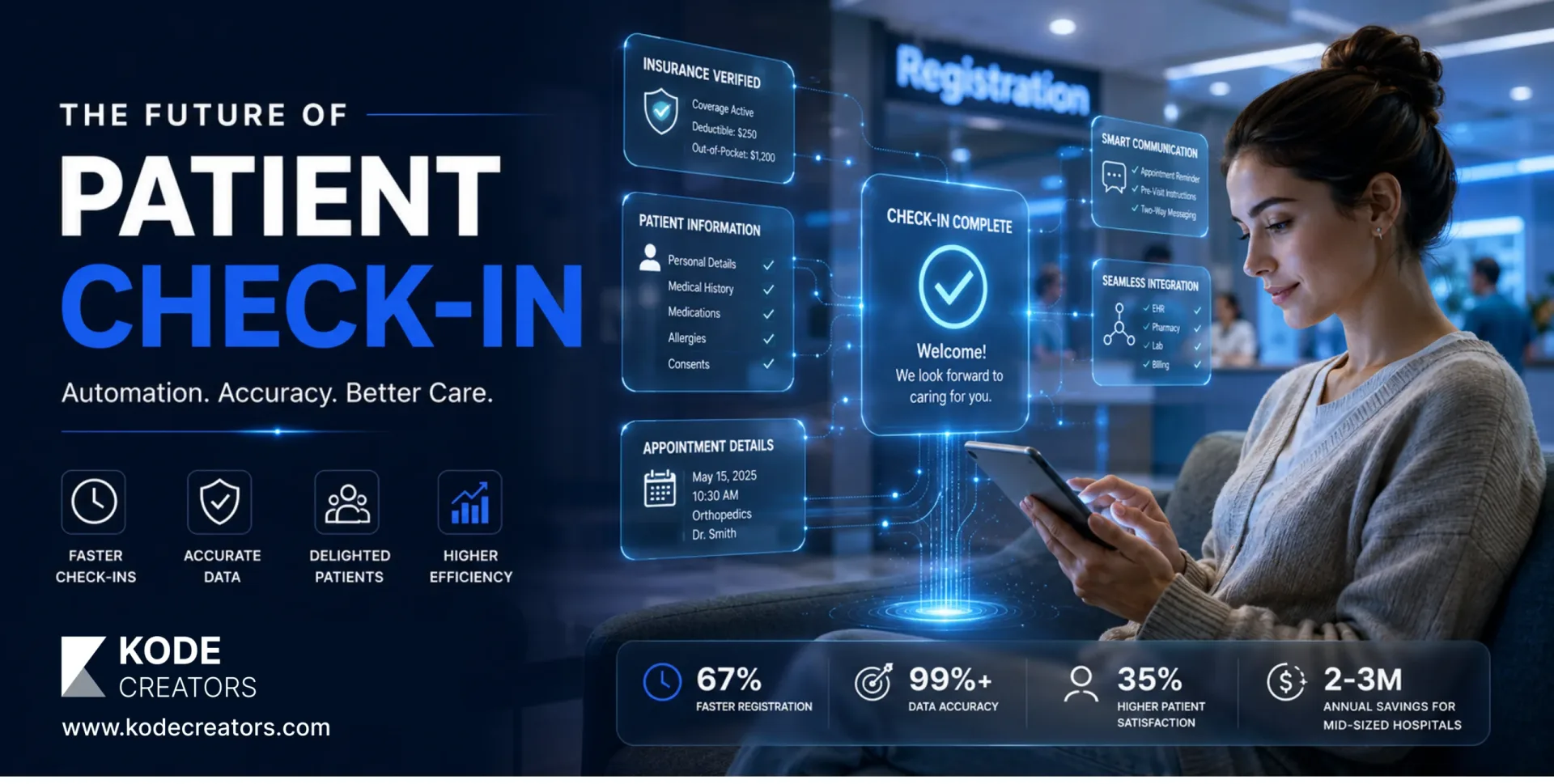
Hospitals are fed up with the morning chaos at registration desks. Patients grip clipboards, trying to recall their medication names. Staff rush to type unreadable writing into EHR systems. The waiting area fills up, tempers flare, and your skilled nurses waste time on data entry rather than caring for patients. That pricey medical assistant? They’ve spent three hours on the phone with insurance companies every single day. This daily routine is on its way out. Top healthcare centers now sign up patients before they step out of their homes. This cuts down registration time by 67% and almost wipes out typing mistakes that cause claim rejections and health risks.
Automation in patient onboarding goes beyond turning paper forms into digital ones. It creates smart systems that check insurance coverage on their own, update all departments at once, and start coordinating care before patients show up. This change improves both how hospitals run and how happy patients are: sign-up times fall below 10 minutes, nurses can spend more time with patients instead of doing paperwork, and the information collected is almost always correct. For healthcare groups dealing with tired staff and money issues, automated onboarding isn’t just a nice extra – it’s becoming key to doing well rather than just getting by.
Let’s learn more about how automation can transform patient onboarding in hospitals.
Understanding Patient Onboarding in the Modern Hospital Context
Patient onboarding is healthcare’s most underestimated process. It starts the moment someone schedules an appointment and doesn’t end until every department has what they need to provide care. We’re talking identity verification that proves you’re actually you, insurance checks that determine whether you’ll go bankrupt from this visit, and medical histories that might save your life.
Get onboarding wrong, and everything falls apart. That minor typo in an insurance ID creates a billing nightmare six months later. The missed medication allergy might send your patient into anaphylactic shock. The incomplete consent form stops a surgery cold while lawyers get paged. Poor onboarding doesn’t just frustrate – it kills efficiency, destroys revenue, and occasionally harms patients.
Automation really turns this mess into staged precision. Instead of five different people asking about your medications, one smart system captures it once and shares it everywhere. Instead of waiting for Sharon to call Blue Cross and verify coverage, algorithms check instantly. Automation in healthcare totally redesigns the process entirely around the radical idea that patients and staff have better things to do than paperwork.
The Traditional Onboarding Workflow (and Its Pain Points)
Watch the traditional onboarding disaster unfold at any hospital without automation in healthcare. Patient arrives, gets handed a clipboard with forms they swear they’ve filled out before. They squint at tiny boxes, trying to remember if Dad had diabetes or heart disease, definitely one of those. Reception takes the barely legible forms and starts the world’s worst data entry job – deciphering whether that’s a 7 or a 1 in the phone number while the patient sits there wondering why this is taking so long. Someone photocopies insurance cards on a machine older than most medical students. Another person calls insurance companies, sitting on hold, listening to smooth jazz while the pre-op patient gets increasingly anxious.
The errors multiply faster than bacteria. Sometimes that Lisinopril gets entered as Lithium. The insurance group number that looked like 8B4D21 was actually 884021. Nobody can read whether the patient circled “yes” or “no” for previous surgeries.
The consent form for the procedure? It’s somewhere in that filing cabinet, probably. Or maybe it never got signed because the patient was rushed through registration when things got busy. Staff members spend 30-45 minutes per patient doing work that robots could handle in seconds. During flu season, the registration desk looks like air traffic control during a storm – overwhelmed, understaffed, and one mistake away from cascade failure.
Patients hate every second. They’ve told three different people about their latex allergy, yet somehow it’s not in the system. They filled out these exact forms six months ago, but apparently, hospitals don’t believe in saving data. Staff hate it more. Nurses making $40 an hour spend that time typing. Registration workers get screamed at for delays they can’t control. Everyone knows there’s a better way, but nobody has time to fix it because they’re too busy managing the current disaster.
What Automation Changes: From Tasks to Orchestrated Workflows
Digital Forms & e-Signatures: Here’s what actually happens now – patients get a text 48 hours before their appointment with a secure link. They complete forms while watching Netflix, with smart logic that adapts to their answers. Say you’ve never had surgery? Those 20 surgery questions vanish. Diabetic? Here come the glucose monitoring questions. The system pulls forward everything from the last visit, so you’re verifying, not re-entering. Invalid insurance number? You know immediately, not after treatment. E-signatures happen with a finger swipe, legally binding without killing trees.
ID & Insurance Verification: Patients snap photos of their cards with their phones. OCR technology reads them instantly – no more manual typing of those 37-character member IDs. RPA bots immediately ping insurance systems, verifying coverage, checking deductibles, identifying prior auth requirements. What used to take 15 phone calls now happens in 15 seconds. The system even catches things humans miss, like coverage that expired yesterday or procedures requiring pre-certification.
Smart Data Transfer: This is where the magic happens – data flows everywhere it needs to be, instantly, accurately. Update an allergy in registration; it appears in pharmacy, nursing, and anesthesia systems simultaneously. No more playing telephone where “allergic to penicillin” becomes “allergic to peanuts” after five handoffs. APIs ensure everyone works from identical information.
Automated Appointment Scheduling: The AI knows Dr. Smith needs 45 minutes for new patients but only 15 for follow-ups. It knows MRI machine 2 is down for maintenance Tuesdays. It sees patterns humans miss – like the fact that 3 PM appointments have 40% no-show rates. Patients self-schedule into slots that actually work while the system handles the complex orchestration invisible to them.
Automated Communication: Forget generic reminders. The system knows you always run late from work, so it texts your reminder earlier. It knows you prefer email to phone calls. Pre-visit instructions arrive based on your specific procedure, not generic templates. Questions get answered through two-way texting without anyone waiting on hold.
The Architecture Behind Automated Onboarding
The tech stack running modern onboarding would blow the mind of anyone still using fax machines. RPA bots handle the grunt work – they’re software robots that click buttons, move data, and check systems exactly like humans would, except they work 24/7 without coffee breaks or typos. These aren’t sophisticated AI systems; they’re reliable workhorses following exact rules. Click here, copy this, paste there, verify it matches, move on. One bot can do the work of three registration clerks without getting carpal tunnel.
Integration layer: This is where hospitals usually fail spectacularly. You’ve got Epic talking to Cerner talking to some billing system from 1997. Nothing speaks the same language. Modern integration platforms act like universal translators – FHIR standards for new systems, HL7 for legacy ones, and custom APIs for everything else. Middleware sits in the middle, converting data formats on the fly. When the scheduling system says “John Smith, DOB 1/15/1950,” the EHR receives it in whatever format it expects.
AI components: This is like adding brains to the automation. Natural language processing reads doctor’s notes about “patient appears anxious about procedure” and flags for pre-op counseling. Machine learning spots patterns – like the fact that patients from certain ZIP codes have higher no-show rates and need different reminder strategies. These aren’t magic; they’re statistical models getting smarter with every patient interaction.
Cloud infrastructure: It makes everything scalable and reliable. Monday morning registration rush? Systems scale automatically. Power outage at the main campus? Everything fails over to redundant systems. Data is encrypted at the source, travels through secure channels, and rests in locked vaults. HIPAA compliance isn’t bolted on afterward; it’s built into every component. The entire flow, from patient phone to hospital dashboard – happens in seconds, with every step logged, monitored, and backed up.
Measurable Benefits of Automation
Operational Efficiency: The numbers are stupid good. Registration drops from 24 minutes of clipboard hell to 8 minutes of quick verification. One registration desk handles triple the volume without adding staff. That medical assistant spending two hours daily on insurance verification? They’re now spending those hours with patients. The scheduling department that needed five people to manage? Two people now handle twice the volume.
Patient Experience: Satisfaction scores jump 35% when you stop treating people like paperwork factories. They complete forms from their couch in their pajamas, not standing at a desk while sick. They arrive knowing their insurance is verified, their copay amount, and exactly where to go. No more answering “what medications are you on?” seventeen times. The respect for their time and intelligence shows in every interaction.
Data Accuracy: Humans make mistakes – about 1 in every 10 manual entries has an error. Automation drops this to essentially zero. No more misread handwriting turning 50mg into 500mg. No more transposed insurance numbers causing claim denials. Complete data capture means doctors have full pictures, not fragments. That accuracy translates directly into better care and fewer billing headaches.
Cost Efficiency: Mid-sized hospitals save $2-3 million annually on labor alone. Claim denials drop 40% when registration data is correct. Paper and storage costs – surprisingly expensive at scale – disappear. Operating rooms run on schedule when registration doesn’t create bottlenecks. The ROI hits positive within six months, sometimes sooner.
Scalability: Busy season doesn’t require hiring temps who need training. Volume spikes get absorbed without degrading service. Opening a new facility? Copy the automation framework, adjust for local requirements, and go live in weeks instead of months. Growth doesn’t mean proportional administrative bloat anymore.
Implementation Roadmap: How Hospitals Can Get Started
Start with brutal honesty about the current state. Time every step of your onboarding process. Count the errors. Calculate the costs. Document the patient complaints. This baseline data becomes your business case for automation. Without it, you’re guessing at problems and can’t measure improvements. One hospital discovered its “quick” registration actually averaged 47 minutes. Another found 30% of their claim denials traced to registration errors nobody knew about.
Set specific goals that matter. “Improve efficiency” means nothing. “Reduce registration time to under 10 minutes” is measurable. “Eliminate paper forms by Q3” is achievable. “Reduce insurance-related claim denials by 50%” has a clear ROI. Goals determine technology choices – if your main problem is insurance verification, start there, not with digital signatures.
Choose technology based on reality, not aspirations. Hospitals with 20-year-old EHRs need different solutions than those running the latest versions. RPA can bridge legacy systems that’ll never have modern APIs. Cloud platforms deploy faster but require security vetting. On-premise solutions offer control but demand IT resources. Start with pilot programs in single departments before hospital-wide rollouts.
Make compliance your co-pilot, not your afterthought. Legal and compliance teams should shape automation design, not review it after building. Document how each automated step maintains or improves compliance. Plan audits before go-live, not after problems surface.
Train for adoption, not just usage. Show staff how automation helps them, not abstract efficiency gains. The nurse who saves 30 minutes on documentation needs to know that. Address job security fears directly – automation eliminates tasks, not positions. Identify champions who’ll support struggling colleagues. Success depends more on change management than technology.
The Future: Intelligent and Predictive Onboarding (2025 and Beyond)
AI assistants will replace forms entirely. Instead of checking boxes, patients will have conversations. “Tell me about your medical history” becomes a dialogue where AI asks intelligent follow-ups, clarifies ambiguities, and even detects emotional states requiring human intervention. These aren’t chatbots with scripts; they’re medical interpreters that understand context, nuance, and urgency. Multilingual capabilities mean every patient gets onboarded in their preferred language, with cultural competence built in.
Predictive systems will anticipate needs before patients know them. Historical patterns will identify who needs financial counseling before bills shock them. Previous visit data will predict likely questions and provide answers proactively. Patients with mobility issues will automatically get closer parking. Those with anxiety about procedures will trigger counseling referrals. The system learns from every interaction, getting smarter about what each patient needs.
IoT integration will start onboarding before arrival. Wearables will transmit baseline vitals during registration. Glucose monitors will share trends that adjust diabetic protocols. Smart scales will update weights for medication dosing. This isn’t just data collection; it’s pre-arrival triage that prepares care teams for what’s walking through the door.
Omnichannel onboarding will meet patients wherever they are. Start on your phone, continue on a kiosk, finish with voice commands. Authentication through biometrics means no passwords to forget. Partial completions save automatically across all channels. The system adapts to patient preferences, not forcing everyone through identical workflows.
Cross-department collaboration will transform discrete tasks into coordinated care. Admitting a surgical patient will automatically trigger pharmacy preparation, dietary notifications, therapy scheduling, and discharge planning. Every department will know its role before the patient arrives. Onboarding becomes the conductor of a healthcare symphony where every section plays in harmony.
Conclusion:
Hospitals still processing paper forms while patients order groceries through smart refrigerators aren’t just behind – they’re becoming irrelevant. The technology changing patient onboarding isn’t experimental or unproven. It’s operational in hundreds of facilities, delivering measurable improvements in every metric that matters. The gap between automated and manual hospitals widens daily, measured in patient satisfaction, staff retention, and financial performance. Every day spent asking patients to fill out redundant forms is a day competitors spend providing better care. The question isn’t whether to automate patient onboarding – it’s whether you’ll lead this transformation or explain to your board why patients chose the hospital that respects their time.
Related Blogs
We analyse the mobile app industry and provide executive
summaries on
trends, mistakes, projections, and data.