




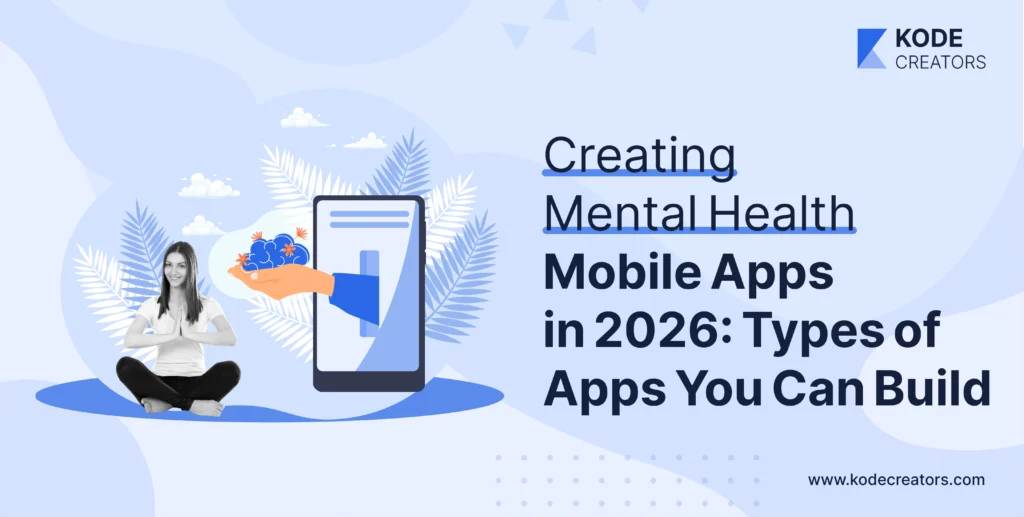
Mental health care is moving to phones. Not just supplementing in-person therapy—replacing it for millions of people.
Patients want convenience. They want privacy. They don't want to sit in waiting rooms or explain to their employer why they need two hours off for a therapy appointment. Apps solve that.
But the mental health app space is crowded and confusing. Meditation apps sit next to teletherapy platforms sitting next to AI chatbots. Some are wellness tools. Some are actual medical interventions. The lines blur.
If you're building a mental health app, the first decision isn't what features to include. It's what type of app you're actually making. Because that determines everything—regulations, business model, user expectations, and whether you're helping people or just adding noise.
Understanding the Mental Health App Ecosystem
Mental health apps span three categories that developers constantly confuse. Wellness apps promote general mental wellbeing – think meditation timers and gratitude journals. Support apps provide tools for managing diagnosed conditions – mood tracking for bipolar disorder, CBT exercises for anxiety. Clinical SaaS connects users with licensed professionals or provides medical-grade interventions requiring regulatory approval.
Users don't move through these categories linearly. Someone might start with meditation for stress (prevention), add mood tracking when they notice patterns (monitoring), connect with a therapist through telepsychiatry (treatment), and keep a crisis hotline app ready (emergency management). The best apps recognize this journey isn't a straight line but a messy path with setbacks, breakthroughs, and everything between.
Regulation shapes everything. HIPAA compliance isn't optional once you store health information. GDPR means European users can demand data deletion even if it breaks your analytics. Digital Therapeutics (DTx) standards separate medical-grade apps from wellness tools, determining whether you need FDA clearance or can launch tomorrow. Trust frameworks matter because mental health data is more sensitive than financial records – breach someone's meditation history and watch your company implode from user revolt.
Choosing an app type depends on your intersection of audience and goal. Building for teenagers requires different features than serving corporate wellness programs. Helping anxiety sufferers needs different validation than supporting addiction recovery. The market's big enough for specificity – the winners won't be generic "mental health" apps but focused solutions for specific problems.
Types of Mental Health Apps You Can Create in 2026
1. Meditation and Mindfulness Apps
The gateway drug of mental health apps, meditation platforms convert skeptics into believers through simple, non-threatening stress reduction. Guided sessions range from three-minute breathing exercises to hour-long deep dives. Micro-practices fit into commutes, lunch breaks, and bathroom stalls where users actually need stress relief, not when they have perfect quiet spaces.
Features that matter: sleep sounds that actually induce sleep (rain recordings, not whale songs), breathing programs synchronized with haptic feedback, progress streaks that motivate without shaming breaks. Visual breathing guides help beginners who can't "empty their mind" but can follow a circle expanding and contracting. Integration with wearables provides biofeedback – seeing heart rate drop during meditation proves it's working.
Calm and Headspace own this space through content quality, not technical innovation. Their moat is celebrity narrators and production values, not revolutionary features. Monetization comes through subscription tiers ($70/year consumer, $500/employee corporate packages), with corporate wellness licensing providing predictable revenue. The opportunity isn't competing with giants but finding underserved niches – meditation for ADHD, mindfulness for chronic pain, breathing exercises for panic attacks.
2. Therapy and Telepsychiatry Apps
Connecting users with licensed professionals sounds simple until you realize every state has different licensing requirements, insurance reimbursements vary wildly, and matching algorithms must balance clinical fit with availability. These apps aren't just video chat with payment processing – they're complex healthcare platforms managing credentials, notes, prescriptions, and crisis protocols.
Real-time sessions require sub-100ms latency or therapeutic rapport breaks. Audio quality matters more than video – nobody opens up when constantly asking "what did you say?" Matching algorithms consider specialties, treatment modalities, personality fit, and practical factors like schedule alignment. HIPAA compliance shapes every technical decision from server selection to session recording policies.
The future includes AI co-therapists that don't replace humans but augment them. They transcribe sessions (with consent), highlight important moments, track homework compliance, and flag concerning patterns between sessions. Imagine therapists reviewing AI-generated summaries highlighting progress, setbacks, and intervention opportunities rather than recreating conversations from memory. The technology exists – the challenge is implementation that enhances rather than undermines therapeutic relationships.
3. Mood & Emotion Tracking Apps
Digital mood rings that actually work, these apps transform vague feelings into trackable data. Daily check-ins use sliding scales, color selections, or emoji grids to capture emotional states. Journaling prompts extract context – what triggered today's anxiety? What helped yesterday's depression? Pattern visualization reveals connections users miss: mood crashes every Sunday night, anxiety spikes during ovulation, depression worsens in winter.
Wearable integration adds objective data to subjective reporting. Heart rate variability indicates stress before users feel it. Sleep patterns predict mood changes. Activity levels correlate with emotional states. The combination of self-reported and biometric data creates unprecedented insight into mental health patterns. Predictive analytics identify triggers and warning signs – alerting users that conditions similar to previous depressive episodes are emerging.
Privacy becomes paramount when apps know users' darkest moments. Data must be encrypted, anonymized, and deletable. Sharing features require careful design – supporting accountability without enabling surveillance. The best apps empower users with insights while maintaining absolute control over their information.
4. Cognitive Behavioral Therapy (CBT) Tools
CBT apps translate therapeutic techniques into interactive exercises anyone can practice. Thought challenging modules help users identify and reframe negative patterns. Behavioral activation schedules pleasant activities combating depression. Exposure exercises gradually reduce phobias. These aren't just digitized worksheets – they're adaptive programs that adjust difficulty, provide real-time feedback, and track progress across sessions.
Gamification makes tedious exercises engaging. Points for completing thought records. Badges for consecutive days challenging negative thoughts. Leaderboards (anonymized) for exposure challenges. The game mechanics aren't trivializing mental health – they're leveraging psychological principles that drive engagement and habit formation.
Evidence-based design requires clinical validation. Partner with psychologists who ensure exercises follow established protocols. Conduct trials comparing app-based CBT to traditional therapy. Publish results transparently, including where apps fall short. Claims of effectiveness without evidence aren't just unethical – they're legally dangerous as regulators crack down on mental health apps making unsupported promises.
5. AI-Powered Chatbots and Virtual Companions
Available 24/7 when crisis hotlines have hour waits and therapists are booked solid, AI chatbots provide immediate support using large language models trained on therapeutic conversations. They don't diagnose or provide therapy – they listen, validate, and guide users toward appropriate resources. Natural language processing means users can express feelings naturally rather than selecting from prescribed options.
Context awareness prevents dangerous responses. The AI remembers previous conversations, recognizes crisis language, and understands when "I'm fine" means anything but. Resource linking connects users with relevant tools – breathing exercises during panic attacks, crisis hotlines during suicidal ideation, therapist directories when professional help is needed.
Ethical boundaries are absolute. Chatbots must clearly identify as AI, not pose as human therapists. Escalation protocols trigger when conversations indicate immediate danger. Limitations are stated upfront – this is support, not treatment. The best implementations position AI as a bridge to human help, not a replacement for it.
6. Community and Peer-Support Platforms
Isolation amplifies mental health struggles. Community platforms connect people facing similar challenges – social anxiety sufferers supporting each other through exposure challenges, depression fighters sharing what actually helps, addiction recovery groups maintaining sobriety together. Professional moderation prevents these spaces from becoming echo chambers of negativity or dangerous advice.
Privacy-first profiles let users engage authentically without risking real-world consequences. Anonymous usernames, encrypted messages, and granular sharing controls protect vulnerable users. Social accountability features – checking in on absent members, celebrating milestones, supporting during setbacks – create genuine connections despite digital distances.
7 Cups pioneered peer support with trained listeners providing emotional support. TalkLife created global communities around specific struggles. The opportunity lies in specialized communities – postpartum depression, caregiver burnout, chronic illness mental health – where shared experience provides unique value.
7. Specialized Apps for Conditions
Generic mental health apps fail users with specific conditions. Anxiety apps need different features than PTSD tools. Bipolar disorder requires mood tracking that catches manic episodes, not just depression. Addiction recovery apps must handle relapses compassionately, not punitively. Specialization isn't limitation – it's focus that actually helps.
Clinician co-design ensures clinical accuracy. Psychiatrists specializing in bipolar disorder know warning signs apps should track. PTSD experts understand trigger patterns algorithms should identify. Addiction specialists recognize recovery stages requiring different support. Building without clinical input guarantees irrelevance at best, harm at worst.
Data monitoring models track outcomes for regulatory approval. Digital Therapeutics designation requires proving effectiveness through clinical trials. Insurance reimbursement demands evidence of cost reduction. The investment in validation pays off through premium pricing, healthcare partnerships, and actual patient impact.
Deciding Which Type to Build: 3 Strategic Filters
Target User: General public apps prioritize accessibility and engagement. Clinician tools focus on workflow integration and evidence documentation. Enterprise wellness programs need admin dashboards, utilization analytics, and ROI metrics. Each audience requires completely different features, interfaces, and success metrics.
Regulatory Scope: Wellness apps launch quickly but can't make medical claims. Medical-grade apps require extensive validation but command premium prices and insurance reimbursement. The middle ground – support tools that don't diagnose but provide clinically-validated exercises – balances speed with credibility.
Business Goal: Habit change apps need engagement mechanics and retention strategies. Therapy access platforms require provider networks and scheduling systems. Insurance partnerships demand outcomes data and cost-reduction evidence. Your business model determines your app type more than your technology stack.
Decision flow: Your idea → Define primary goal → Determine regulatory requirements → Select app type that aligns with all three.
Building Roadmap in Short
Phase 1: Research starts with talking to actual users and clinicians. Academic literature review reveals what works. Competitive analysis shows market gaps. Clinical consultation ensures safety and effectiveness. This phase prevents building solutions for problems that don't exist.
Phase 2: Feature selection requires brutal prioritization. UX wireframing with actual users reveals confusion points. Accessibility from day one prevents expensive retrofitting. Emotional design considerations – calming colors, supportive language, non-judgmental interfaces – shape every screen.
Phase 3: Tech stack depends on requirements. Python + TensorFlow for AI components. Flutter for cross-platform development. AWS HealthLake for HIPAA-compliant infrastructure. GraphQL for flexible data management. WebRTC for video therapy. Choose boring, proven technology over exciting experiments.
Phase 4: Compliance audit before launch prevents catastrophic recalls. Security hardening assumes breach attempts. Privacy review ensures data handling meets regulations. Clinical validation confirms safety. Legal review covers liability and terms of service.
Phase 5: MVP release to limited users reveals real-world problems. Feedback loops that actually reach developers. Rapid iteration based on usage patterns. Gradual scaling as confidence builds. Continuous monitoring for safety issues requiring immediate intervention.
Key Takeaways
Mental health apps live at the intersection of three things: clinical safety, technology, and human empathy. Miss any one of those, and you've built something nobody should use.
Start by knowing what you're building. Not just "a mental health app," but which specific type? Because a wellness app and a therapy platform aren't the same thing. They have different regulations, different user expectations, and different risks.
Compliance matters more here than almost any other app category. People are trusting you with their mental health. Their struggles. Sometimes there are crisis moments. If your privacy policy is vague or your data practices are sketchy, they'll leave. Or worse, they'll stay and get hurt.
The competitive advantage isn't AI features or slick design. It's trust. Build something clinically sound, empathetic, and safe.
That's what separates helpful apps from dangerous ones.