




Talk to any patient at midnight with a health concern, and they'll tell you - healthcare is broken in all the most annoying ways. You can video-call someone on the other side of the planet, but getting basic medical advice at 10 PM? Good luck with that. While 73% of patients now expect digital health support around the clock, most of us are still stuck between Dr. Google's doom-scrolling diagnosis and expensive ER visits for non-emergencies.
This is exactly why healthcare organizations are turning to AI chatbots – and no, not because they're trendy or look good in board presentations. They're solving real problems. The healthcare chatbot market is exploding from $1.2 million to a projected $1.6 billion by 2032 because these tools actually work. They're handling millions of patient questions, cutting wait times, and most importantly, getting people the help they need when traditional healthcare can't keep up. As the bridge between overwhelmed hospitals and anxious patients, they are always available, never judgmental, and surprisingly good at what they do.
Let’s learn more about how these AI-powered chatbots work and help patients more with their advanced capabilities.
What Are AI-Powered Chatbots in Healthcare?
Forget everything you know about chatbots. Those annoying "press 1 for billing" bots that make you want to scream into the void? Yes, healthcare AI chatbots aren't even close relatives to those digital disasters.
Traditional rule-based bots follow scripts. You say "headache," they respond with pre-written answer A. But AI-powered healthcare chatbots? They get context. When you type "my head's been killing me since that fall yesterday," they understand you're not being dramatic – you might have a concussion. This is made possible through Natural Language Processing (NLP) and Machine Learning (ML) services. NLP lets them decode your "my stomach turns upside down" into an actual medical concern, while ML helps them learn from millions of patient conversations to get smarter over time.
They can distinguish between "chest feels tight when I'm stressed" and "crushing chest pain with left arm numbness" – and respond appropriately to each. One gets breathing exercises; the other gets immediate emergency protocol.
But here's the crucial part everyone needs to understand: these chatbots aren't gunning for your doctor's job. They're more like having the world's best medical receptionist who speaks every language, never sleeps, remembers everything, and knows exactly when to say, "You need to see a real doctor. Now." They handle the routine questions drowning medical staff – prescription refills, appointment scheduling, basic symptom checking – so actual humans can focus on actual medicine. Your doctor stays your doctor; they just get a really smart virtual assistant who handles the time-consuming stuff that keeps them from doing what they trained for: taking care of you.
Core Benefits of AI Chatbots for Patient Engagement
Patient-Centric Benefits: What Your Patients Actually Want
24/7 Engagement
Nobody gets sick on schedule. That panicked parent at 2 AM, the elderly patient with Sunday evening chest discomfort, the chronic pain sufferer who can't sleep – they all need help now, not during office hours. AI chatbots fill this massive gap and provide legitimate medical guidance when traditional channels are closed. For chronic disease management, this round-the-clock support transforms outcomes – patients stay engaged with care plans because someone (or something) is always there.
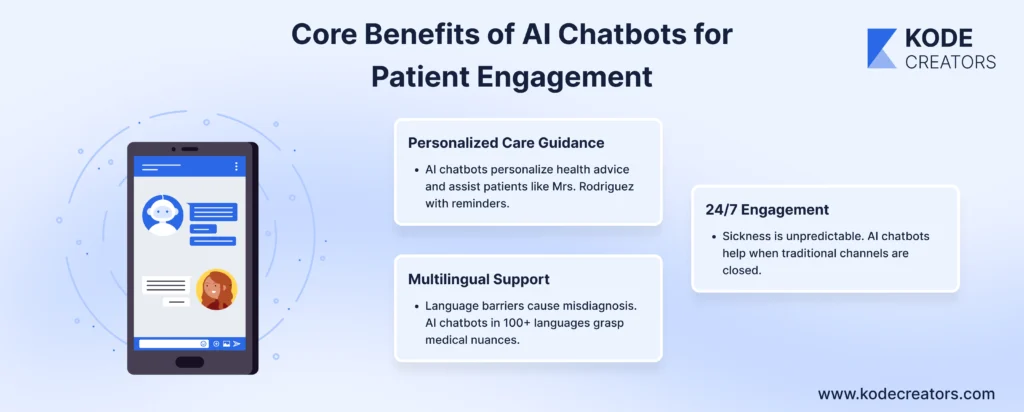
Multilingual Support
Language barriers are literally killing patients through misdiagnosis and medication errors. AI chatbots speaking 100+ languages aren't just running words through Google Translate. They understand medical nuance in Mexican Spanish versus Argentinian Spanish, know that "feeling hot" means different things in different cultures, and can navigate the linguistic minefield of medical terminology across dialects.
Personalized Care Guidance
Cookie-cutter health advice is why most patient education fails spectacularly. AI chatbots get personal – really personal. They remember that teenage patients ghost formal medical language but respond to casual check-ins. They know Mrs. Rodriguez takes pills better with picture reminders, and that anxiety patients require extra reassurance before procedures. This is all about understanding what actually makes each patient tick. Result? Triple the adherence rates of generic automated systems.
Healthcare Provider Benefits:
Reduced Administrative Workload
Doctors burning out aren't overwhelmed by complex surgeries – they're drowning in "what's my blood type?" calls and prescription refill requests. The average physician wastes nearly half of their day on administrative burden. AI chatbots handle this repetitive paperwork, giving providers back 15 hours weekly. That's 15 hours for actual patient care, complex diagnosis, or radical idea – maybe actually leaving work on time.
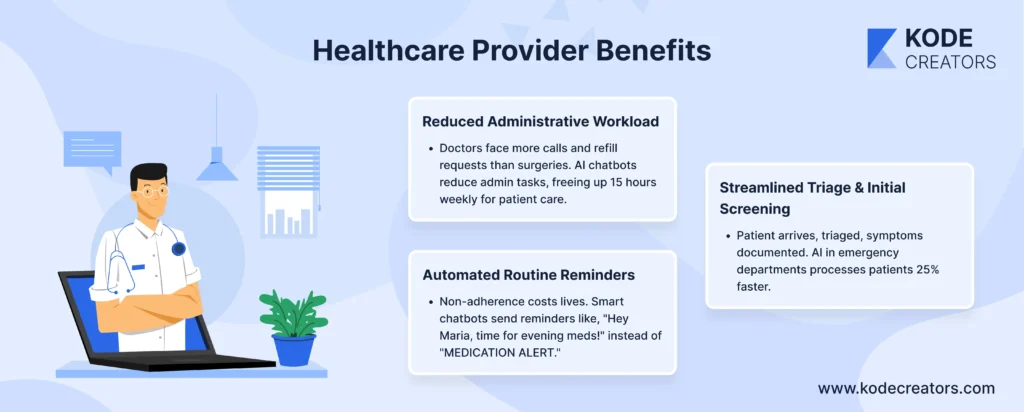
Automated Routine Reminders
Medication non-adherence costs more lives than car accidents, but nagging doesn't work. Smart chatbots know the secret: timing and tone. They send reminders when patients actually check phones, in language that resonates, with encouragement that doesn't feel patronizing. "Hey Maria, evening medication time! How was dinner?" beats "MEDICATION ALERT" every time.
Streamlined Triage & Initial Screening
Picture this: patient arrives, already triaged, symptoms documented, history reviewed, urgency assessed. No more playing 20 questions while someone's in pain. Emergency departments using an AI triage process patients 25% faster with better accuracy.
Operational & Strategic Benefits
Data Insights for Hospital Management
Every chatbot conversation is intelligence gathering. Suddenly, administrators see patterns invisible before – why Tuesday afternoons flood with mental health queries, which medications cause the most confusion, and where service gaps frustrate patients the most. This isn't just data; it's a real-time radar for community health needs, guiding everything from staffing decisions to preventive program development.
Improved Accessibility in Underserved Areas
Rural communities where the nearest cardiologist is 200 miles away suddenly have immediate cardiac guidance. Uninsured populations get health education without bankruptcy-inducing bills. Non-English speakers navigate byzantine health systems without translator delays. This is democratizing healthcare access in ways legislation couldn't achieve in decades.
Practical Use Cases in Action
Symptom Checkers & Triage:
Remember the last patient who showed up after three sleepless nights of WebMD diving? AI symptom checkers end that madness. They ask the right questions in the right order – not random symptom fishing that leads everyone to rare tropical diseases. When someone reports chest pain, the chatbot doesn't panic or dismiss. It systematically evaluates: crushing or sharp? Radiating pain? Shortness of breath? Previous cardiac history? Within minutes, it determines whether they need an ambulance, an urgent care visit, or just anxiety management techniques.
Not least, these chatbots learn urgency patterns. They know Saturday night "stomach pain" in college towns might be different from Tuesday morning stomach pain in retirement communities. That's the sweet spot – fewer worried-well clogging the system, more actually-sick getting timely care.
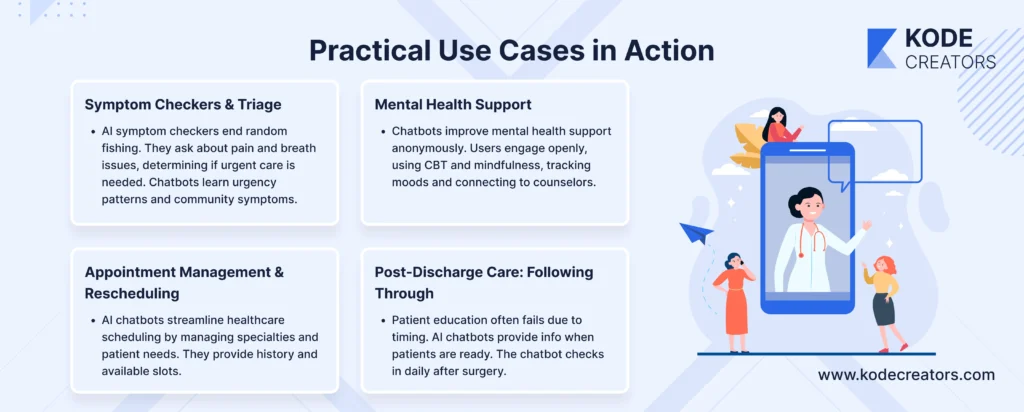
Appointment Management & Rescheduling:
Appointment scheduling is healthcare's most underrated nightmare. It's not just booking slots – it's matching provider specialties, equipment availability, patient preferences, insurance requirements, and preparation protocols. AI chatbots handle this complexity without breaking a sweat.
Patient messages "need to see someone about my knee." The chatbot knows this patient's orthopedic history, insurance coverage, previous provider preferences, and even that they prefer afternoon appointments due to morning stiffness. It offers appropriate slots, sends prep instructions ("wear loose clothing for examination"), and handles the inevitable rescheduling when life happens.
Mental Health Support:
The surprising thing is, mental health chatbots have higher engagement rates than traditional therapy intake. Why? Zero judgment, infinite patience, and complete anonymity. That executive having panic attacks at 3 AM isn't ready to admit weakness to a human, but they'll tell a chatbot everything.
These aren't just "feeling sad? Try yoga!" bots. They use legitimate therapeutic frameworks – CBT, DBT, mindfulness protocols – delivered conversationally. They recognize crisis language, track mood patterns, and know exactly when to escalate: "I'm noticing you've mentioned feeling hopeless several times. I'd like to connect you with our crisis counselor immediately." Universities using mental health chatbots report 60% of users eventually seeking human therapy – students who never would've walked into counseling centers without that digital stepping stone.
Patient Education & Post-Discharge Care: Actually Following Through
Traditional patient education fails because timing is everything. Handing someone 50 pages about diabetes management right after diagnosis is like explaining calculus during a fire. AI chatbots deliver education when patients are ready to receive it.
Post-discharge support is where readmission rates plummet. The chatbot checks in daily after hip replacement: "Pain level today? Any swelling? Ready for today's exercises?" It catches complications early – that slight fever on day five that might indicate infection, the medication confusion that could cause serious problems.
Implementation Roadmap: From Idea to Live Chatbot
Step 1: Define Clear Goals (Or Watch Everything Burn)
"Let's build a chatbot" isn't a strategy - it's a recipe for failure. Get specific: Are you drowning in appointment calls? Losing patients to poor follow-up? Fighting readmission penalties? Your pain points determine everything else. Write measurable goals that make accountants happy: "Reduce call volume 40% in six months" beats "improve patient engagement" every time. Pro tip: involve the people actually dealing with these problems daily.
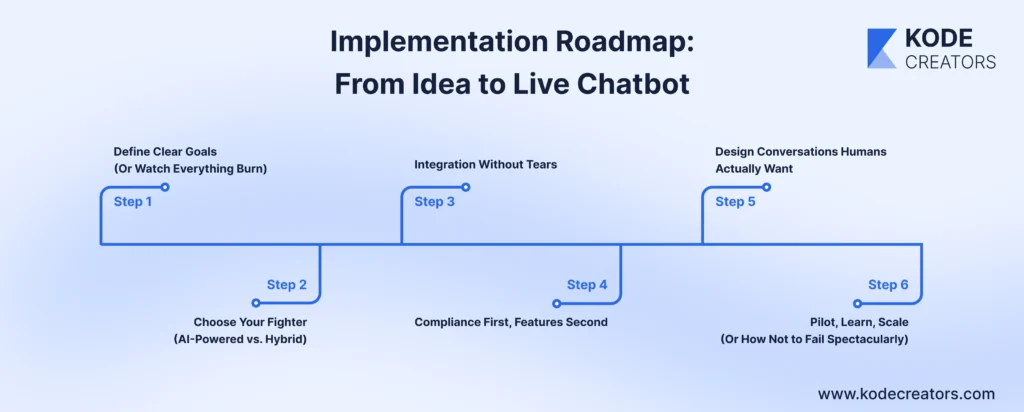
Step 2: Choose Your Fighter (AI-Powered vs. Hybrid)
Pure AI chatbots are like race cars – they have incredible performance, but they need expert handling. Hybrid models (mixing AI with rule-based logic) are reliable SUVs – less flashy but won't leave you stranded. Most successful implementations start hybrid. Why? Control and predictability. You can hard-code critical pathways (chest pain always triggers emergency protocol) while letting AI handle conversational nuance. As you gather data and confidence, gradually unleash more AI capabilities. Starting too ambitious is how chatbots end up telling patients to put ice on heart attacks.
Step 3: Integration Without Tears
EHR/EMR integration is where dreams go to die – unless you plan properly. Your chatbot needs to integrate smoothly with existing systems, seamlessly pull patient histories and update records. Modern APIs make this easier, but budget 3-6 months for integration gymnastics. Start with read-only access (chatbot can view but not modify records) to minimize risk. Test with non-critical data first.
Step 4: Compliance First, Features Second
HIPAA violations aren't just expensive – they're trust-destroying catastrophes. Every chatbot interaction needs encryption, audit trails, and access controls that would make security experts weep with joy. GDPR adds another layer if you're dealing with international patients. This isn't negotiable corner-cutting territory. Partner with vendors who abide by compliance, who can explain their security measures without stammering, who treat patient privacy like their own mother's medical records.
Step 5: Design Conversations Humans Actually Want
Medical accuracy means nothing if patients hate talking to your chatbot. The best healthcare chatbots sound like experienced nurses – professional but warm, clear but not condescending. They say, "I understand this is concerning" not "Error: invalid symptom." They remember context, acknowledge emotions, and know when to shut up and escalate. Test conversations with real patients, not just medical staff. That terminology that seems "simple" to providers might be gibberish to patients.
Step 6: Pilot, Learn, Scale (Or How Not to Fail Spectacularly)
Launch small – one department, one use case, controlled environment. Choose early adopters wisely (tech-comfortable teams with genuine problems to solve). Run for 3-6 months, measuring everything: conversation success rates, escalation patterns, user satisfaction, and edge cases where the chatbot struggled. Scale gradually, using success stories to convert skeptics.
Challenges & How to Overcome Them
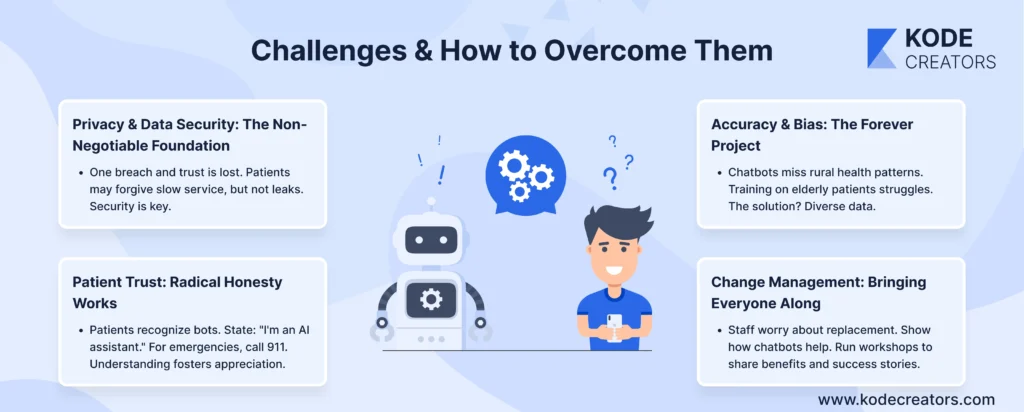
Privacy & Data Security: The Non-Negotiable Foundation
One data breach and you're done. Not just legally done ( HIPAA breach averages $1.5 million in fines) – trust done. Patients may forgive slow service, but they don't forgive leaked psychiatric records. The solution is only one: compliance-first everything. Every vendor conversation starts with security. Every feature request gets filtered through privacy requirements. Yes, it slows development. No, you can't skip it. Build your chatbot like hackers are actively targeting it – because they are.
Patient Trust: Radical Honesty Works
Patients aren't stupid – they know when they're talking to a bot. Trying to trick them destroys trust instantly. Instead, lean into transparency: "I'm an AI assistant trained by medical professionals to help with your health questions." Clearly state limitations: "I can help with general guidance, but for emergencies, call 911." Share accuracy rates proudly if they're good (85% triage accuracy beats Dr. Google's 5%). When patients understand what they're dealing with, skepticism evolves into appreciation for 24/7 support.
Accuracy & Bias: The Forever Project
Your chatbot trained on urban hospital data might miss rural health patterns. Training dominated by elderly patient interactions might fail with pediatric cases. The fix? Diverse data, constant monitoring, and regular audits by diverse medical teams. Track every escalation outcome – did human providers agree with the chatbot's assessment? Feed discrepancies back into training.
Change Management: Bringing Everyone Along
Staff resistance is real because fear is real. Nurses think they're being replaced. Doctors worry about liability. Receptionists see unemployment. Address these fears head-on: show how chatbots eliminate drudgework, not jobs. Run hands-on workshops where staff see chatbots handling their most hated tasks. For patients, use success stories over feature lists. "Mrs. Johnson caught her infection early thanks to our health assistant," beats "AI-powered with NLP capabilities" every time.
Future Outlook: Where AI Chatbots Are Heading in Healthcare
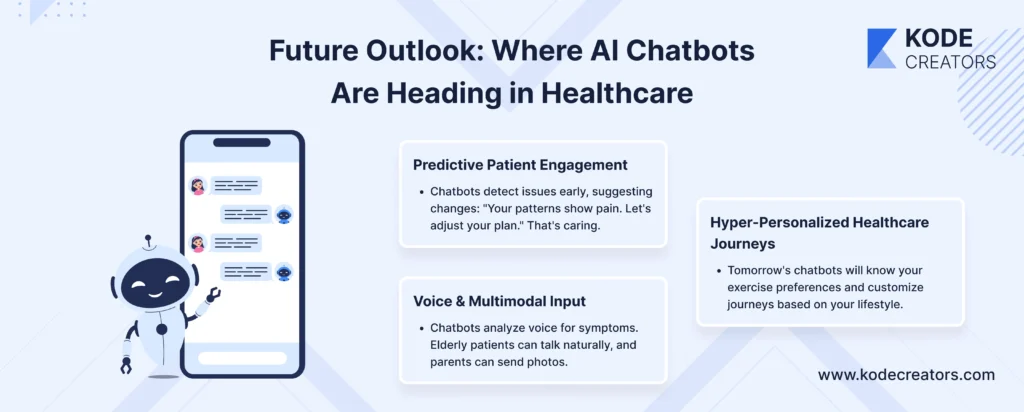
Hyper-Personalized Healthcare Journeys
Forget generic care paths. Tomorrow's chatbots will know you're more likely to exercise with a buddy, that your blood sugar spikes after work stress, and that you respond better to medication adjustments on weekends. They'll customize treatment journeys as unique as fingerprints, adjusting in real-time based on your responses, lifestyle patterns, and even weather changes affecting your arthritis.
Voice & Multimodal Input
Typing symptoms while shaking with fever? Ancient history. Next-gen chatbots will analyze your voice for pain levels, examine rashes through photos, and even detect breathing problems through audio. Elderly patients will just talk naturally. Parents will snap photos of kids' symptoms. The chatbot becomes accessible to everyone, regardless of tech literacy or physical limitations.
Predictive Patient Engagement
The real revolution? Chatbots that act before problems start. They'll notice subtle pattern changes – sleep disruption preceding depression episodes, activity drops indicating medication non-compliance, and communication changes suggesting cognitive decline. Instead of waiting for patients to report problems, chatbots will reach out: "Your activity patterns suggest you might be experiencing pain flare-ups. Let's adjust your management plan." That's not just better healthcare; that's healthcare that actually cares.
Final Thoughts
Implementing AI chatbots in healthcare is all about fixing what's fundamentally broken – patients can't get help when they need it, providers are drowning in administrative quicksand, and entire communities lack basic healthcare access. The organizations getting this right aren't the ones with the biggest budgets or flashiest tech stacks. They're the ones who understand that successful chatbot implementation is 20% technology and 80% understanding what actually irritates patients and providers daily. Start small, learn constantly, and never forget – these tools work best when they make healthcare more human, not less. The technology is ready. The patients are ready. The only question left is: are you?