





Every mobile app begins with a spark of an idea, but it takes more than a spark to develop a high-performing product. It requires a well-thought-out, deliberate development strategy that manages costs and strives to achieve as much impact as possible. It’s never been more critical to plan and execute your app development in the right way because it’s something users expect seamless experiences and businesses want to see measurable returns.
How do you know that a strategy is really effective? It’s about focus, and that is understanding who your audience is, what tools you should use, and what challenges you should start preparing for before they actually happen. In this guide, we’ll take you through the proven practices and overlooked nuances that guide app creators through this complicated journey. Whatever you’re doing - whether you’re building your first app, or refining your development processes, these insights will help you to get results that matter.
1. Conduct Thorough Market Research
Before you start coding or designing screens, you need to know what's going on in the market where your app will compete. Market research isn't just about collecting data—it's about finding insights that can guide your app's direction, improve its features, and set it up for success.
Look Into What Your Target Audience Wants and Needs
Understanding your users and their needs is crucial for any app's success. Market research helps you spot pain points, expectations, and behaviors your app can tackle. Spend time grouping your audience into personas based on things like age, location, interests, and behaviors. This helps you pinpoint the features and design elements that will click with them.
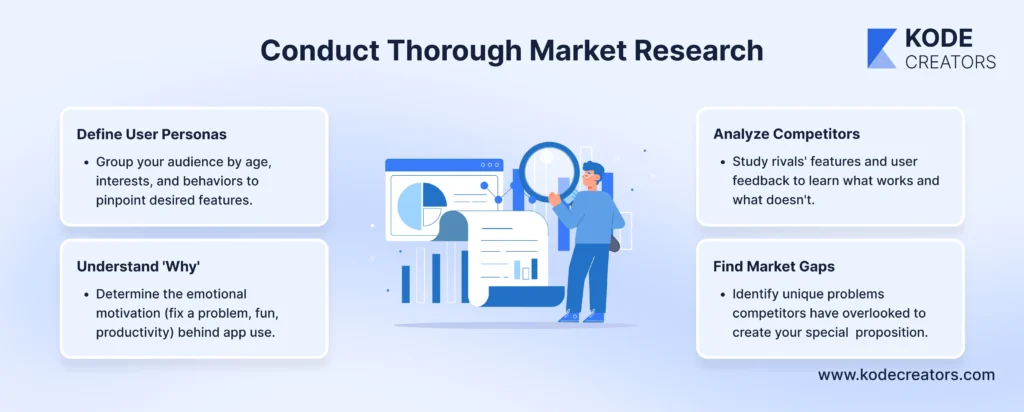
Besides demographics, you need to grasp the emotional reasons behind their app use. What pushes them to download an app, and what keeps them hooked? Whether it's fixing a problem providing fun, or boosting productivity, this insight will steer your user-focused choices.
Study Competitors to Identify Market Gaps and Opportunities
Your rivals' strong and weak points are treasure troves of insights. They've already paved the way—by looking at what worked and what didn't for them, you can figure out what to copy and what to steer clear of. Check out how they design their user interfaces, what features they include, and what their users are saying.
What's more, pay attention to what they're leaving out. Are there any features or problems they've overlooked that your app could tackle? What unique value can you bring to the table that nobody else is offering? Spotting gaps in the market will help you create a special place for yourself and give people a reason to pick your app over the rest.
A deep dive into market research makes sure your product meets what people want while also standing out in a sea of competitors.
2. Set Clear Targets and Aims
Every successful app starts with a clear purpose. If you don't have well-defined targets, your projects can lose focus, spend too much, or miss deadlines. Setting specific aims makes sure your team is on the same page and that every choice helps the app succeed.
Create SMART Goals for the App
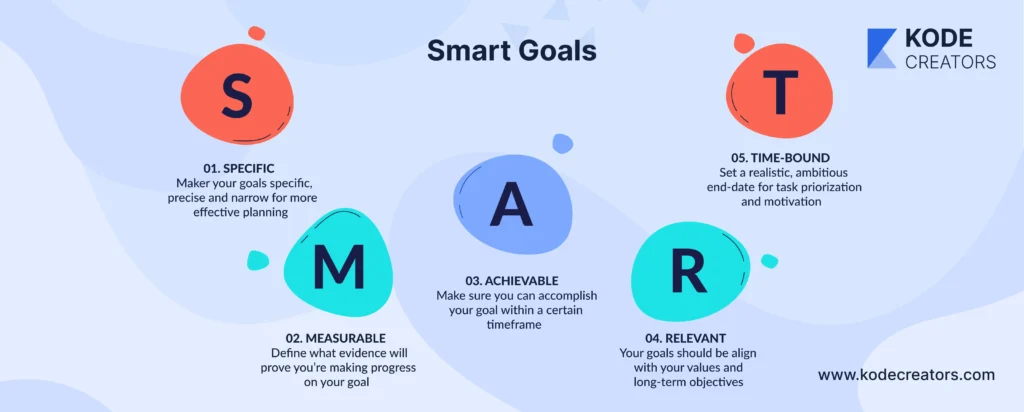
SMART goals—Specific, Measurable, Achievable, Relevant, and Time-bound - are a tested way to turn dreams into concrete steps. Here's how they apply to making mobile apps:
- Specific: Decide what you want the app to accomplish. For instance, do you aim to improve internal workflows, boost user interaction, or make money?
- Measurable: Set up ways to monitor progress, like tracking app downloads how many people use it, or how your keep customers coming back.
- Achievable: Be realistic about what your team can do, how much you can spend, and how long it'll take. Don't promise too much, or you might delay the launch.
- Relevant: Make sure your goals fit with your overall business plan. If your company wants to build customer loyalty, focus on features that get users more involved.
- Time-bound: Set deadlines for each stage of development to keep the project moving forward. For example, try to finish user testing in three months or reach 10,000 downloads in the first three months after launch.
When you split your goals into smaller steps, you create a plan that directs every part of development.
Match Development Processes with Business Aims
Your app's success isn't just about technical know-how - it's also about how well it backs your company's wider aims. Take a moment to think about how the app fits into the big picture:
- Making Money: If the app should bring in cash, think about ways to earn like subscriptions, things to buy in the app, or ads.
- Growing the Brand: For apps that aim to boost brand awareness, focus on design that shows off your brand's look and helps people remember it.
- Working Smarter: If the app is for in-house use, focus on features that fix specific work problems or help people do more.
Constant talks between dev teams and business partners are crucial to keep everyone on the same page.
When you know what you're after, every part of making the app becomes more targeted, smart, and useful. This crystal-clear vision makes sure your app doesn't just sit there - it shines.
3. Prioritize User-Centric Design
A mobile app’s success hinges on how well it caters to its users. Prioritizing user-centric design ensures that your app is intuitive, enjoyable, and solves real problems. Here are some things to keep in mind.
Implement User Feedback Loops During Development
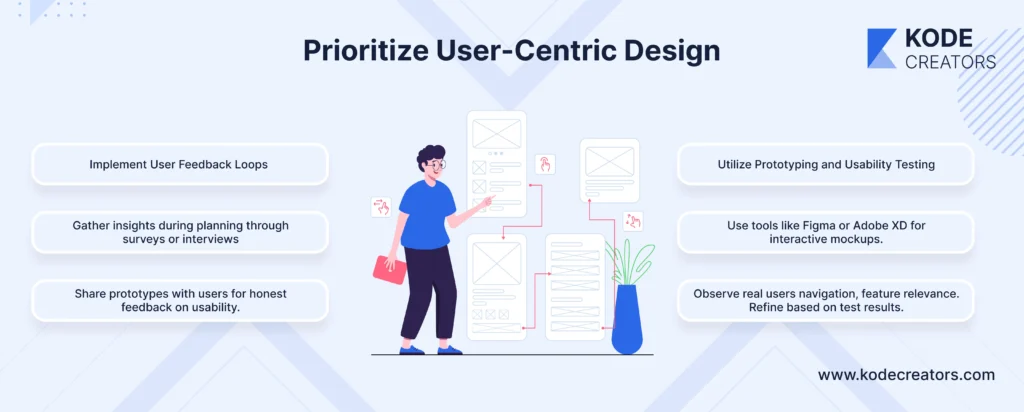
One of the most effective ways to design with users in mind is by integrating feedback loops at every stage of development. Here’s how to do it:
- Early Engagement: Start by gathering insights during the planning phase through surveys, focus groups, or interviews. This will help you understand users’ pain points and expectations.
- Ongoing Feedback: Share early prototypes or beta versions with a selected group of users. Encourage them to provide honest feedback on features, navigation, and overall usability.
- Iterative Improvements: Use the feedback to make informed adjustments to your design. For instance, if users find a feature confusing, refine its layout or functionality to align with their expectations.
Utilize Prototyping and Usability Testing to Refine User Experience
Before committing to full-scale development, prototypes allow you to visualize and test the app’s design and functionality. This step is essential for identifying potential issues early in the process.
- Prototyping: Tools like Figma, Adobe XD, or Sketch enable you to create interactive mockups that simulate the user experience.
- Usability Testing: Once you have a working prototype, conduct usability tests to observe how real users interact with the app. Key elements to focus on include:
- Ease of Navigation: Can users complete tasks quickly and intuitively?
- Feature Relevance: Are the app’s features solving users’ core problems?
- Visual Appeal: Does the design feel clean, consistent, and engaging?
- Iterative Refinement: Based on the results of usability tests, tweak the prototype and test again. This iterative approach ensures the app evolves into a polished product that delivers a seamless user experience.
4. Choose the Right Technology Stack
The technology stack you choose directly impacts your app’s performance, scalability, and maintenance. A carefully selected stack ensures that your app is efficient today and adaptable for future growth.
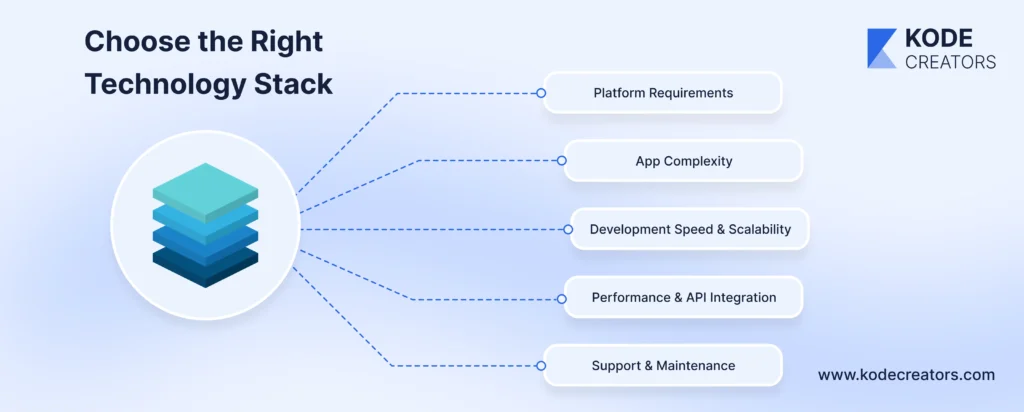
Evaluate Programming Languages, Frameworks, and Tools
When selecting your technology stack, consider:
- Platform Requirements:
- For iOS, Swift and Objective-C are standard choices.
- For Android, Kotlin and Java are widely used.
- For Cross-Platform, frameworks like Flutter and React Native enable development for both platforms with a single codebase.
- App Complexity: Advanced functionalities may require specific tools, such as TensorFlow Lite for AI or Firebase for backend integration.
- Development Speed: If time is critical, use frameworks like Ionic or Xamarin that speed up the process.
Consider Future Scalability and Maintenance
Your app should accommodate growth and remain easy to maintain:
- Scalability: Use cloud services like AWS or Google Cloud to support growing user bases. Choose a modular architecture to allow seamless updates.
- Performance: Select tools optimized for handling user loads, like Node.js for backend or Swift for responsive interfaces.
- Integration: Ensure compatibility with third-party APIs and services.
- Support: Use actively maintained technologies to reduce risks of obsolescence.
Aligning your technology choices with your project requirements will ensure your app reaches its full potential today and in the future.
5. Adopt Agile Development Methodologies
Agile methodologies are causing a revolution in app development. They put flexibility, teamwork, and ongoing enhancement first. This strategy allows teams to adapt to changes making sure the end product meets user needs and business goals well.
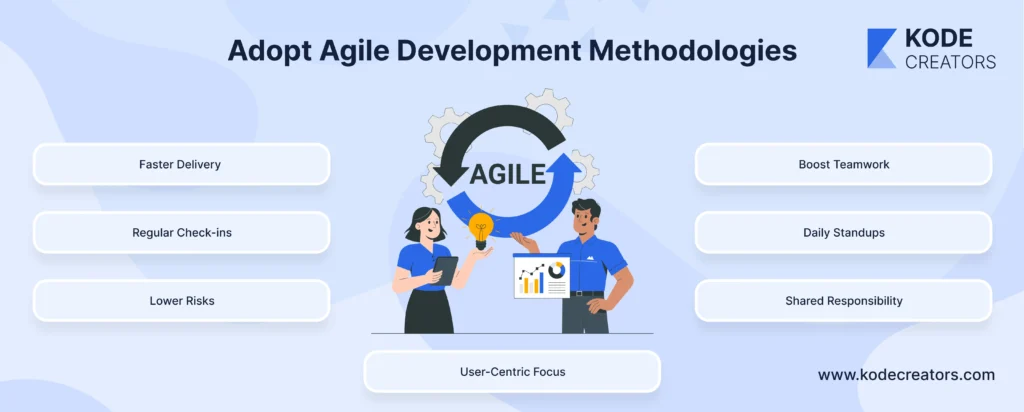
Embrace Iterative Development
Agile centers on iterative cycles, or sprints. In these sprints, teams build, check, and improve features in small manageable parts. This approach has many upsides:
- Faster Delivery: Breaking the project into smaller tasks lets teams deliver working app parts bit by bit cutting down the time to launch.
- Regular Check-ins: Agile gives you room to use feedback and shift gears when needs change, without having to redo the whole project.
- Lower Risks: Non-stop testing in each sprint helps spot and fix potential problems on.
Boost Teamwork Across Departments
Agile works best when teams join forces and talk. This includes everyone involved in making the app, from designers and coders to testers and business people:
- Daily Standups: Regular meetings help everyone stay on the same page about progress, problems, and what's important.
- Shared Responsibility: Agile pushes for everyone to take ownership of the project, which boosts accountability and involvement.
- User-Centric Focus: Teams that work together can better use feedback from users making sure the app meets what the audience wants.
When you use Agile methods, you set up a lively development space that not produces top-notch results but also keeps the team fired up and in line with what the project aims to do. This step-by-step, team-based approach makes sure your app grows along with what users need and what's trending in the market.
6. Make Sure Your App Works on Different Platforms
Nowadays, people want mobile apps that work well no matter what kind of phone or tablet they're using, be it an iPhone, Android, or something else. When your app runs across various platforms more people can use it, and everyone gets the same great experience.
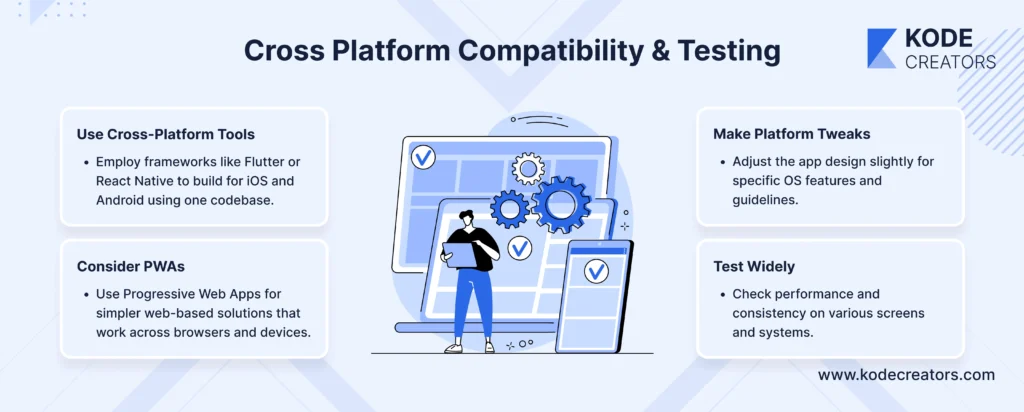
Come Up with Ways to Make Your App Work on Multiple Platforms
To get your app running on different systems, think about these methods:
- Cross-Platform Frameworks: Tools like Flutter, React Native, or Xamarin help you build apps with one codebase that runs on both iOS and Android. These frameworks cut down on time and development expenses.
- Progressive Web Apps (PWAs): For more basic apps, PWAs provide a web-based answer that works across devices through browsers, getting rid of the need to create separate versions of the app.
- Platform-Specific Tweaks: While using one codebase is effective, you might need to make small changes for each platform to handle unique operating system features or design rules.
Test on Multiple Devices
Thorough testing makes sure your app works the same way across different platforms and devices:
- Device Testing: Check your app on many devices with different screen sizes, resolutions, and hardware specs.
- Performance Benchmarking: Assess how well your app runs on both operating systems to spot and fix platform-specific slowdowns.
- User Testing: Get feedback from users on different platforms to make sure the app feels easy to use and the same everywhere.
7. Plan to Scale Up
When you build a mobile app, you shouldn’t only consider the current market scenario, you also need to consider scalability. When an app is scalable, it will run smoothly as more users join and data grows, reducing the chance of software crashes or poor user experiences.
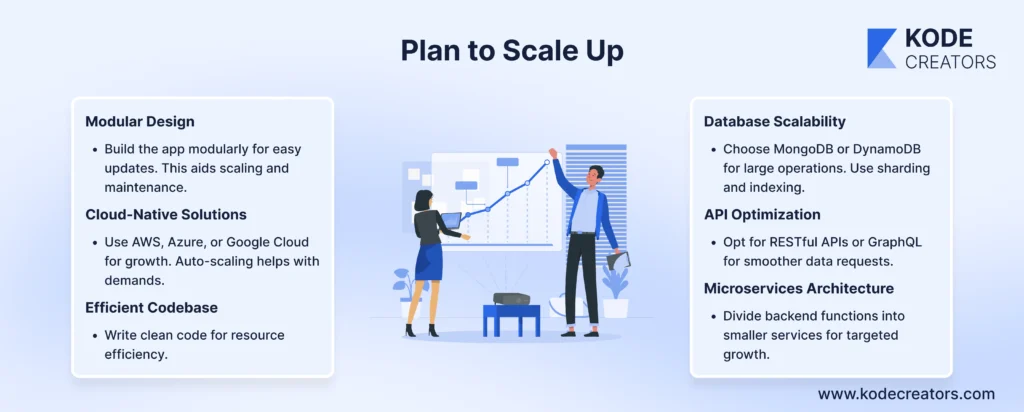
Design an App Structure That Can Grow
The basis for scaling up is in how you build your app. Key things to think about are:
- Modular Design: Create the app with a modular structure. This lets you update or expand individual parts without impacting the whole system. This method makes scaling and upkeep easier.
- Cloud-Native Solutions: Use cloud platforms like AWS, Microsoft Azure, or Google Cloud. These offer flexible setups that grow with your app. Services like auto-scaling and load balancing help manage changing user needs.
- Efficient Codebase: Craft clean streamlined code to use fewer resources and ensure smooth operation under heavy use.
Build Scalable Backend Services and Databases
Your app's backend needs to be strong enough to support growing user numbers and increased data flow:
- Database Scalability: Pick databases like MongoDB or Amazon DynamoDB, which can handle big operations. Use sharding and indexing to manage data better.
- API Optimization: Go for RESTful APIs or GraphQL to make data requests smoother and boost backend talk.
- Microservices Architecture: Split backend functions into smaller separate services. This way, you can grow specific features without changing the whole system.
8. Put Strong Testing Methods into Action
Testing plays a key role to make sure your app works under different circumstances. Well-organized and comprehensive testing methods help find bugs, boost performance, and make the user experience better before launch.
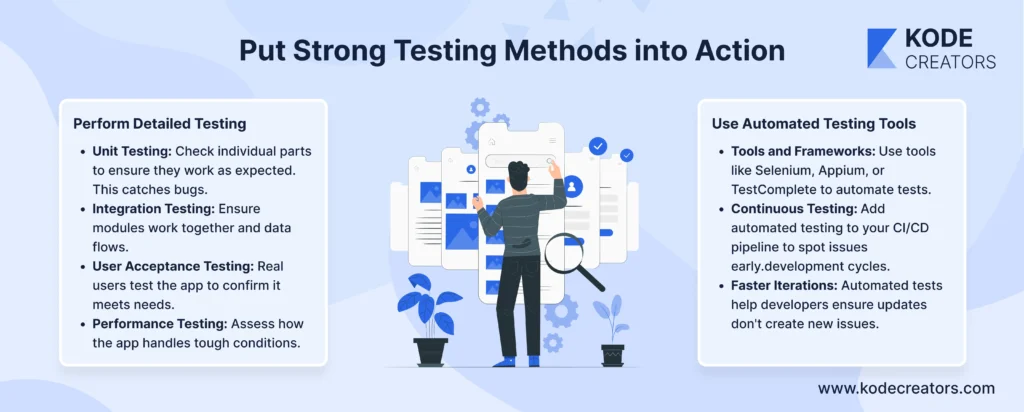
Perform Detailed Testing
A testing approach with many layers makes sure all parts of your app are checked:
- Unit Testing: Check individual parts or functions to make sure they as expected and right. This often catches bugs.
- Integration Testing: Check if different modules of your app work well together making sure data moves between them.
- User Acceptance Testing (UAT): Get real users to try out the app in everyday situations. UAT helps confirm the app meets user needs and works as planned.
- Performance Testing: See how the app handles tough conditions, like lots of users or big data jobs, to find possible slowdowns.
Use Automated Testing Tools
Automation makes testing more productive for tasks you do over and over:
- Tools and Frameworks: Make use of tools such as Selenium, Appium, or TestComplete to automate functional, regression, and performance tests.
- Continuous Testing: Add automated testing to your CI/CD pipeline to spot problems early and speed up development cycles.
- Faster Iterations: Automated tests let developers check changes making sure updates and fixes don't create new problems.
When you put strong testing methods in place, you lower the chance of errors after launch and deliver a top-notch app that lives up to what users want. Thorough testing doesn't just save time and money - it also builds trust with your audience.
9. Focus on Security Measures
Security stands as a key part of making mobile apps keeping user data and your app safe. Taking steps to boost security not only protects important info but also makes users trust you more, which is key to your app's success.
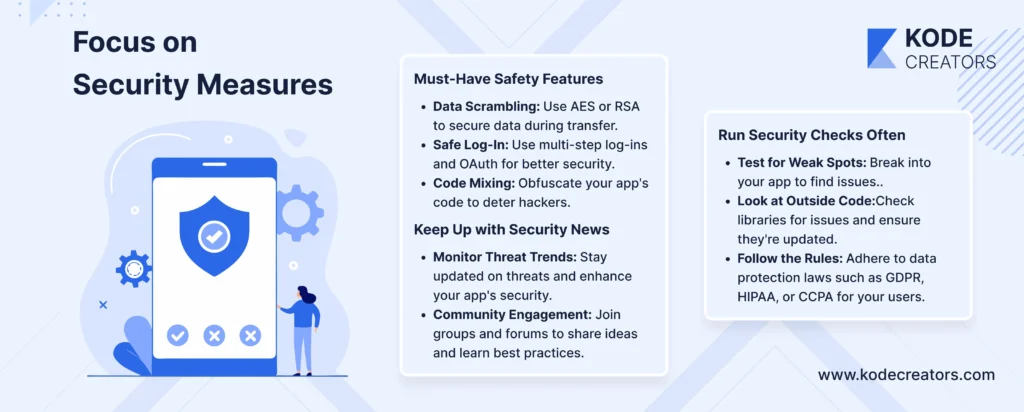
Add Must-Have Safety Features
Put these core safety steps into your app-making process:
- Data Scrambling: Use scrambling methods like AES or RSA to keep data safe when it moves and when it sits still so user info stays secure even if someone grabs it.
- Safe Log-In: Use multi-step log-ins and OAuth rules to make logging in safer and stop users who unauthorized sign-in.
- Code Mixing: Mix up your app's source code to make it harder for hackers to take it apart or find weak spots.
Run Security Checks Often
Checking your app's security helps you stay one step ahead of potential risks:
- Test for Weak Spots: Try to break into your own app to find problems before hackers do.
- Look at Outside Code: Check the libraries and frameworks you use for known issues and make sure they're up to date.
- Follow the Rules: Stick to data protection laws like GDPR, HIPAA, or CCPA, based on who uses your app and what it does.
Keep Up with Security News
The world of online safety changes fast, so it's key to stay in the loop:
- Monitor Threat Trends: Stay informed about new threats and improve your app's protection as needed.
- Community Engagement: Take part in security groups and forums to exchange ideas and learn from what others in the industry are doing well.
When you make strong security a key part of how you build your app, you don't just lower risks. You also build trust with the people who use your app and this eventually leads your app for long-term success.
10. Create a Full Launch Strategy
Launching a mobile app goes beyond just making it downloadable. It's about generating excitement, connecting with users, and establishing systems for ongoing support. A planned launch strategy helps your app make a lasting first impression and gain momentum.
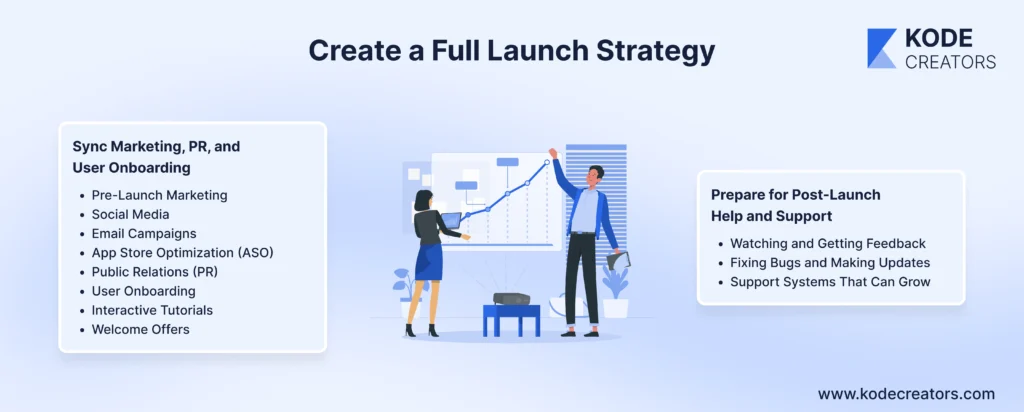
Sync Marketing, PR, and User Onboarding
- Pre-Launch Marketing: Create excitement with focused campaigns, including:
- Social Media: Show teasers, demos, and countdowns to get your audience interested.
- Email Campaigns: Tell subscribers about launch dates and special features.
- App Store Optimization (ASO): Make your app store listings better with keywords, great visuals, and interesting descriptions to help people find your app easily.
- Public Relations (PR): Team up with industry experts, bloggers, and reporters to spread the news. A press release showing your app's unique value can help create a buzz.
- User Onboarding: Create an easy-to-use onboarding experience with:
- Interactive Tutorials: Guide users through the app's features with ease.
- Welcome Offers: Give users perks such as discounts or free trials to spark early interest.
Prepare for Post-Launch Help and Support
- Watching and Getting Feedback: Use analytics tools to track how users act and how well the app runs. Keep an eye on reviews and what users say to spot ways to make things better.
- Fixing Bugs and Making Updates: Be set to tackle problems fast and push out updates to keep users running.
- Support Systems That Can Grow: Set up help and support systems to help customers using quick chat or FAQs, and phone support so you can help users.
A full launch plan doesn't just make sure things start off well, it also builds a strong base for doing well over time.
11. Post Launch Support and Monitoring
The job isn't done when you release your app. To compete and keep users interested, you need to watch and improve it all the time. Work after launch helps your app grow with what users want and what's new in the market.
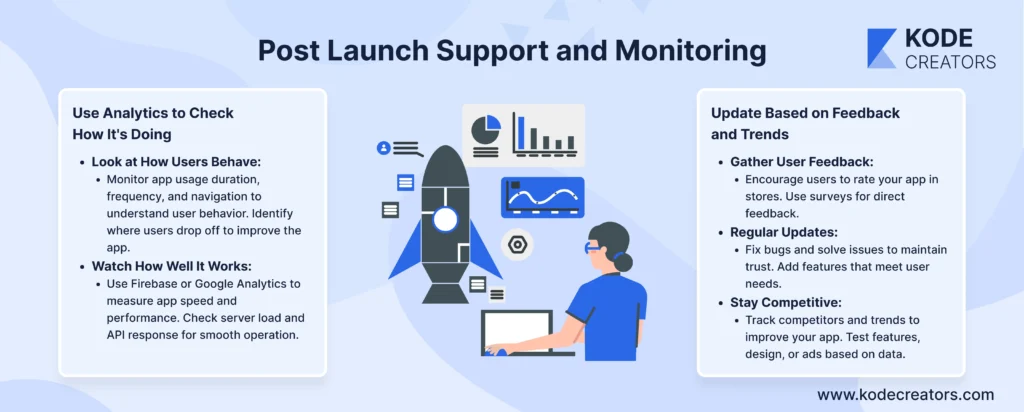
Use Analytics to Check How It's Doing
- Look at How Users Behave:
- Keep an eye on things like how long people use the app how often they come back, and how they move through it to understand how people use your app.
- Find where people stop using the app to fix problems and make it better to use.
- Watch How Well It Works:
- Use tools like Firebase, Google Analytics, or Mixpanel to measure how fast the app is how often it crashes, and other signs of how well it's working.
- Check how busy the server is and how the API responds to make sure everything runs when things change.
Update Based on Feedback and Trends
- Gather User Feedback:
- Ask users to review and rate your app in app stores.
- Use surveys or forms in your app to get direct input from your audience.
- Regular Updates:
- Fix bugs and solve issues users report to keep their trust and make them happy.
- Add new features that match what users need now or what new tech can do.
- Stay Competitive:
- Watch what your competitors do and what's new in your field to keep your app useful.
- Try out new features, change how things look, or start new ad campaigns based on what your data shows.
Final Thoughts
Building a mobile app is not the only step for optimizing a mobile app development strategy, and there is more to it than that: it’s about creating a product that people enjoy, fulfilling business goals, and accommodating future needs. To make sure that you get to the launch as swiftly as possible and in the best possible way, you should concentrate on the most important things, namely market research, clear goals, user-centric design, scaleability and solid testing. As you’ve heard them say, the journey doesn’t end at launch, you need continuous monitoring, updates and improvements to maintain success in the rapidly changing app market.